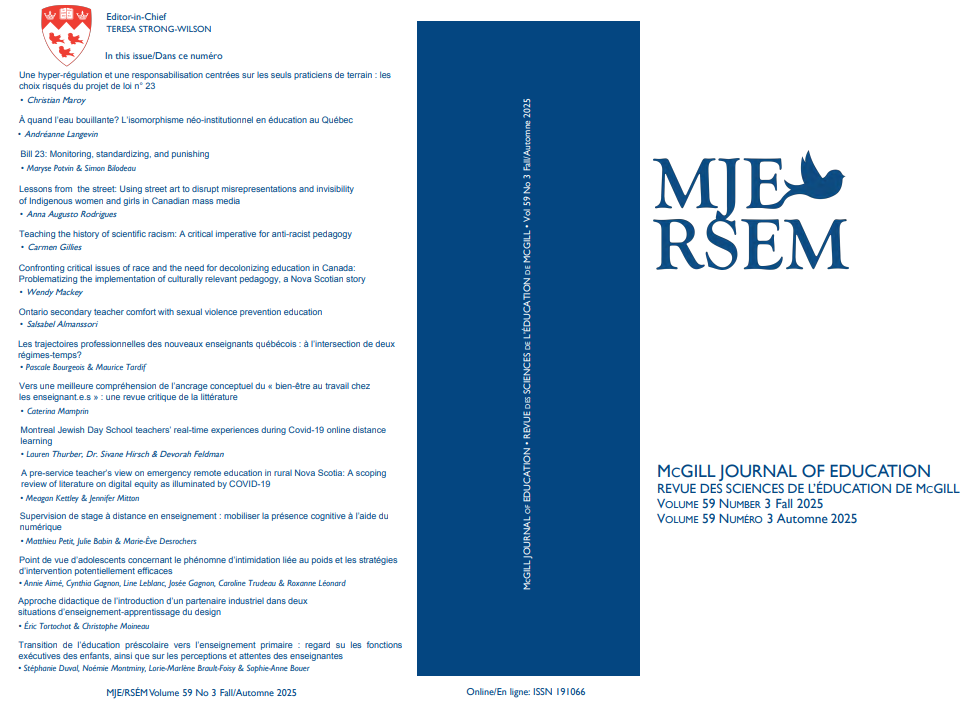
Affronter les enjeux critiques de la race et la nécessité de décoloniser l’éducation au Canada : problématiser la mise en œuvre d’une pédagogie culturellement pertinente, une histoire de la Nouvelle-Écosse
DOI :
https://doi.org/10.26443/mje/rsem.v59i3.10160Mots-clés :
décoloniser, antiracisme, racisme systémique , pédagogie sensible et adaptée à la culture (PSAC), pensée déficitaire , conception des enseignantsRésumé
L’objectif de cet article est d’affronter les enjeux critiques liés à la race et d’apporter une analyse critique manquante des tentatives de mise en œuvre de la pédagogie sensible et adaptée à la culture (PSAC) dans l’éducation en Nouvelle-Écosse et à travers l’Amérique du Nord. Cette analyse critique aborde les environnements d’apprentissage inéquitables auxquels font face les apprenants noirs. Les récits d’enseignants mettent en évidence la nécessité, pour les éducateurs et les responsables scolaires, d’intégrer des démarches de décolonisation afin de mettre en œuvre la PSAC et de surmonter le racisme systémique dans l’éducation. Sans démarches de décolonisation, notamment offrir aux enseignants le temps et l’occasion de décoloniser leur pensée, les efforts visant à mettre en œuvre la PSAC échoueront.
Références
Absolon, K. (2019). Decolonizing education and educators’ decolonizing. Intersectionalities: A Global Journal of Social Work Analysis, Research, Polity, and Practice, 7(1), 9–28. https://doi.org/10.48336/IJUFBE8541
Banks-Wallace, J. (2002). Talk that talk: Storytelling and analysis rooted in African American oral tradition. Qualitative Health Research, 12(3), 410–426. https://doi.org/10.1177/104973202129119892
Bartley, A. (2020). The Ku Klux Klan in Canada: A century of promoting racism and hate in the peaceable kingdom. James Lorimer & Company.
Battiste, M. (2013). Decolonizing education: Nourishing the learning spirit. Purich Publishing.
Battiste, M., Bell, L., & Findlay, L. M. (2002). Decolonizing education in Canadian universities: An interdisciplinary, international, Indigenous research project. Canadian Journal of Native Education, 26(2), 82–85. https://doi.org/10.14288/cjne.v26i2.195923
Bishop, R., O'Sullivan, D., & Berryman, M. (2010). Scaling up education reform: Addressing the politics of disparity. NZCER Press.
Black Learners Advisory Committee. (1994). BLAC report on education: Vol. 1. Redressing inequity —empowering Black learners. https://www.ednet.ns.ca/acs/files-acs/docs/blacreportoneducationvol1-3.pdf
Boyd, D., & Arnold, M. L. (2000). Teachers' beliefs, antiracism and moral education: Problems of intersection. Journal of Moral Education, 29(1), 23–45. https://doi.org/10.1080/030572400102916
Dei, G. J. S. (1999). The denial of difference: Refraining anti‐racist praxis. Race Ethnicity and Education, 2(1), 17–38. https://doi.org/10.1080/1361332990020103
Dei, G. J. S. (2005). Critical issues in anti-racist research methodologies: An introduction. In G. J. S, Dei & G. S. Johal (Eds.), Critical issues in anti-racist research methodologies (pp. 1–28). Peter Lang.
Dei, G. J. S., & Howell Rutherford, C. (2023). Educating against anti-Black/anti-African Canadian Racism. In A. A. Abdi (Ed.), Social justice education in Canada: Select perspectives (pp. 31–48). Canadian Scholars.
Dei, G. J. S., James, I. M., Karumanchery, L. L., James-Wilson, S., & Zine, J. (2000). Removing the margins: The challenges and possibilities of inclusive schooling. Canadian Scholars.
Delpit, L. (2006). Other people's children: Cultural conflict in the classroom (2nd ed.). The New Press.
St. Denis, V., & Schick, C. (2003). What makes anti-racist pedagogy in teacher education difficult? Three popular ideological assumptions. Alberta Journal of Educational Research, 49(1), 55–69. https://doi.org/10.11575/ajer.v49i1.54959
Edmonds, R. (1979). Effective schools for the urban poor. Educational Leadership, 37(1), 15–24. https://files.ascd.org/staticfiles/ascd/pdf/journals/ed_lead/el_197910_ edmonds.pdf
Fitchett, P. G., Starker, T. V., & Salyers, B. (2012). Examining culturally responsive teaching self-efficacy in a preservice social studies education course. Urban Education, 47(3), 585–611. https://doi.org/10.1177/0042085912436568
Ford, D. Y., Harris, J. J., III, Tyson, C. A., & Trotman, M. F. (2001). Beyond deficit thinking: Providing access for gifted African American students. Roeper Review, 24(2), 52–58. https://doi.org/10.1080/02783190209554129
Garcia-Huidobro, J. C., Nannemann, A., Bacon, C. K., & Thompson, K. (2017). Evolution in educational change: A literature review of the historical core of the Journal of educational change. Journal of Educational Change, 18(3), 263–293. https://doi.org/10.1007/s10833-017-9298-8
Gardner-Neblett, N., Iruka, I. U., & Humphries, M. (2023). Dismantling the Black–White achievement gap paradigm: Why and how we need to focus instead on systemic change. Journal of Education, 203(2), 433–441. https://doi.org/10.1177/00220574211031958
Gay, G. (2000). Culturally responsive teaching: Theory, research, and practice. Teachers College Press.
Gay, G. (2010). Culturally responsive teaching: Theory, research, and practice (2nd ed.). Teachers College Press.
Hilliard, A. G., III (1978). Equal educational opportunity and quality education. Anthropology & Education Quarterly, 9(2), 110–126. https://doi.org/10.1525/aeq.1978.9.2.04x0735g
Irving, M. A. (2006). Practicing what we teach: Experiences with reflective practice and critical engagement. In J. Landsman & C. W. Lewis (Eds.), White teachers / diverse classrooms: A guide to building inclusive schools, promoting high expectations, and eliminating racism (pp. 195–202). Stylus Publishing.
James, C. E., & Parekh, G. (2021). Fixed trajectories: Race, schooling, and graduation from a Southern Ontario university. Canadian Journal of Higher Education, 51(4), 67–84. https://doi.org/10.47678/cjhe.v51i4.189081
Kafele, B. K. (2021). The equity & social justice education 50: Critical questions for improving opportunities and outcomes for Black students. ASCD.
Ladson-Billings, G. (1995a). Toward a theory of culturally relevant pedagogy. American Educational Research Journal, 32(3), 465–491. https://doi.org/10.3102/00028312032003465
Ladson-Billings, G. (1995b). But that's just good teaching! The case for culturally relevant pedagogy. Theory Into Practice, 34(3), 159–165. https://doi.org/10.1080/00405849509543675
Ladson-Billings, G. (1995c). Toward a theory of culturally relevant pedagogy. American Educational Research Journal, 32(3), 465–491. https://doi.org/10.3102/00028312032003465
Lee, E. (2009). Reality check: A review of key program areas in the BLAC Report for their effectiveness in enhancing the educational opportunities and achievement of African Nova Scotian learners. Enidlee Consultants. https://www.ednet.ns.ca/docs/realitycheckfinalreportforweb.pdf
Lynch, I., Swartz, S., & Isaacs, D. (2017). Anti-racist moral education: A review of approaches, impact and theoretical underpinnings from 2000 to 2015. Journal of Moral Education, 46(2), 129–144. https://doi.org/10.1080/03057240.2016.1273825
Philip, C. S. (2018, March 27). What Canadians really think of the ‘cultural mosaic.’ Inside Policy. https://www.macdonaldlaurier.ca/what-canadians-really-think-of-the-cultural-mosaic-philip-carl-salzman-for-inside-policy/
Mackey, W. (2018). Diversity, adversity, and determination: Making a difference for African Nova Scotian students. In S. E. Singer & M. J. Harkins (Eds.), Educators on diversity, social justice, and schooling: A reader (pp. 39–57). Canadian Scholars.
Mackey, W. (2020). Intricacies of deep change in system transformation: The case of culturally relevant pedagogy [Unpublished doctoral dissertation]. St. Francis Xavier University.
Mackey, W. (2021). Culturally relevant pedagogy — A diffusion model for district-wide change to address systemic racism. In Education, 27(1), 61–80. https://doi.org/10.37119/ojs2021.v27i1.498
MacLure, M., Jones, L., Holmes, R., & MacRae, C. (2012). Becoming a problem: Behaviour and reputation in the early years classroom. British Educational Research Journal, 38(3), 447–471. https://doi.org/10.1080/01411926.2011.552709
Mallea, J. R., & Young, J. C. (1984). Cultural diversity and Canadian education: Issues and innovations. Carleton University Press.
Marcoux, J., & Nicholson, K. (2020, July 23). Deadly force: Fatal encounters with police in Canada: 2000–2017. CBC. https://newsinteractives.cbc.ca/longform-custom/deadly-force
Maynard, R. (2017). Policing Black lives: State violence in Canada from slavery to the present. Fernwood Publishing.
McCray, C. R., & Beachum, F. D. (2014). Countering plutocracies: Increasing autonomy and accountability through culturally relevant leadership. School Leadership & Management, 34(4), 392–413. https://doi.org/10.1080/13632434.2014.943171
Milner, H. R. (2006). But good intentions are not enough: Theoretical and philosophical relevance in teaching students of color. In J. Landsman & C. W. Lewis (Eds.), White teachers / diverse classrooms: A guide to building inclusive schools, promoting high expectations, and eliminating racism (pp. 79–90). Stylus Publishing.
Nieto, S. (1998). Cultural difference and educational change in a sociopolitical context. In A. Hargreaves, A. Lieberman, M. Fullan, & D. Hopkins (Eds.), International handbook of educational change (Vol. 2, pp. 418–439). Kluwer Academic Publishers.
Nova Scotia Department of Education. (2008). Special education policy. https://www.ednet.ns.ca/docs/specialeducationpolicyen.pdf
Nova Scotia Department of Education and Early Childhood Development. (2016). Individual program plan (IPP) review: Themes and recommendations. https://www.ednet.ns.ca/docs/individualprogramplanreview.pdf
Nova Scotia Department of Education and Early Childhood Development. (2018). Nova Scotia teaching standards: Excellence in teaching and learning: Comprehensive guide. https://www.ednet.ns.ca/psp/files-psp/docs/nsteachingstandardsen.pdf
Nova Scotia Department of Education and Early Childhood Development. (2020a). Inclusive education policy. https://www.ednet.ns.ca/docs/inclusiveeducationpolicyen.pdf
Nova Scotia Department of Education and Early Childhood Development. (2020b). Disaggregated results. https://plans.ednet.ns.ca/disaggregated-results
Peddle, S. (2018, October 19). Speaker revs up teachers at PD day in Halifax. Saltwire. https://www.saltwire.com/nova-scotia/news/speaker-revs-up-teachers-at-pd-day-in-halifax-251577/
Seller, W., & Hannay, L. (2000). Inside–outside change facilitation: Structural and cultural considerations. In N. Bascia & A. Hargreaves (Eds.), The sharp edge of educational change: Teaching, leading and the realities of reform (pp. 217–236). Routledge.
Sensoy, O., & DiAngelo, R. (2017). Is everyone really equal? An introduction to key concepts in social justice education (2nd ed.). Teachers College Press.
Sher, J. (1983). White hoods: Canada's Ku Klux Klan. New Star Books.
Simmons, M. (2023). On decolonial thought and writing Black life. In A. A. Abdi (Ed.), Social justice education in Canada: Select perspectives (pp. 49–60). Canadian Scholars.
Simpson, J. S., James, C. E., & Mack, J. (2011). Multiculturalism, colonialism, and racialization: Conceptual starting points. Review of Education, Pedagogy, and Cultural Studies, 33(4), 285–305. https://doi.org/10.1080/10714413.2011.597637
Smith, T. W. (1899). Collections of the Nova Scotia Historical Society: Vol. 10. The slave in Canada. Nova Scotia Printing Company.
Stanfield, J. H., II (2008). The gospel of feel-good sociology: Race relations as pseudoscience and the decline in the relevance of American academic sociology in the twenty-first century. In T. Zuberi & E. Bonilla-Silva (Eds.), White logic, White methods: Racism and methodology (pp. 271–282). Rowman & Littlefield.
Statistics Canada. (2019, February 27). Diversity of the Black population in Canada: An overview. https://www150.statcan.gc.ca/n1/pub/89-657-x/89-657-x2019002-eng.htm
Syme, P. (2018). We don’t need a raft, we have each other. The Teacher: Nova Scotia Teachers Union, 57(2), 6.
Thobani, S. (2007). Exalted subjects: Studies in the making of race and nation in Canada. University of Toronto Press.
Thompson, A. (1997). For: Anti‐racist education. Curriculum Inquiry, 27(1), 7–44. ttps://doi.org/10.1080/03626784.1997.11075479
Tuhiwai Smith, L. (2012). Decolonizing methodologies: Research and Indigenous peoples (2nd ed.). Zed Books.
Walcott, R. (2018). Against social justice and the limits of diversity: Or Black people and freedom. In E. Tuck & K. W. Yang (Eds.), Toward what justice? Describing diverse dreams of justice in education (pp. 85–100). Routledge.
Wortley, S. (2019). Halifax, Nova Scotia: Street checks report. Nova Scotia Human Rights Commission. https://humanrights.novascotia.ca/sites/default/files/editor-uploads/halifax_street_checks_report_march_2019_0.pdf
Wright, R. S. (2022, January). An African Nova Scotian community calling in: Agency, accountability, representation and self-determination [Conference session]. MacEachen Institute for Public Policy and Governance, Dalhousie University, Halifax, NS, Canada. https://www.youtube.com/watch?v=qgTFSe84jFA
Téléchargements
Publié-e
Comment citer
Numéro
Rubrique
Licence
(c) Tous droits réservés Revue des sciences de l'éducation de McGill 2025

Cette œuvre est sous licence Creative Commons Attribution - Pas d'Utilisation Commerciale - Pas de Modification 4.0 International.