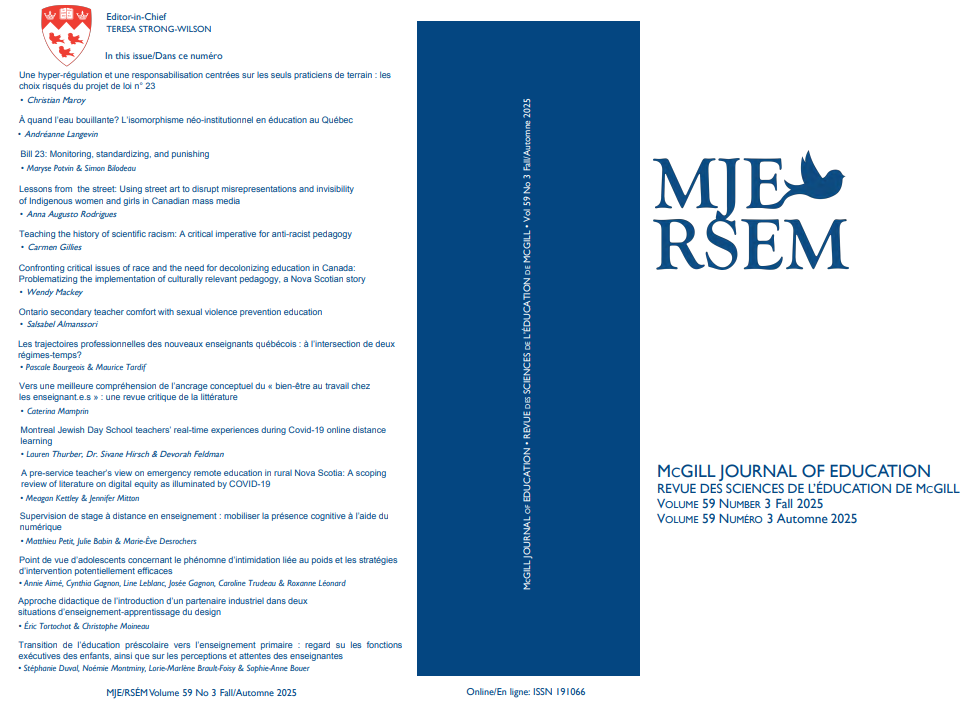
Adolescents’ point of view on weight-based bullying and potentially effective intervention strategies
DOI:
https://doi.org/10.26443/mje/rsem.v59i3.9968Keywords:
weight-based bullying, explanatory factors, consequences, intervention strategies, adolescentsAbstract
Weight-based bullying is frequently observed among high-school students. The objective of this study was to explore adolescents’ point of view on this phenomenon and on the strategies to counter it. To this end, focus group interviews were conducted with 19 adolescents, aged 14 to 17 years old. The interviews explored this specific type of bullying, the explanatory factors, the consequences, and the effectiveness or ineffectiveness of interventions strategies. The adolescents interviewed suggested that weight-based bullying is subtle and has significant consequences. They mentioned that strategies aiming at mobilizing adults and peers toward those who are bullied and at providing them with emotional support should be prioritized. However, sanctions and surveillance should be avoided.
References
Aimé, A., LeBlanc, L. et Maïano, C. (2017). Is weight-related bullying addressed in school-based anti-bullying programs? Revue Européenne de Psychologie Appliquée/European Review of Applied Psychology, 67(3), 163-169. https://doi.org/10.1016/j.erap.2017.02.001
Association pour la santé publique du Québec [ASPQ] (2020). Prévenir et contrer l’intimidation à l’égard du poids dans votre école : guide de pratique à l’intention des enseignants et des intervenants scolaires des écoles primaires du Québec. Bibliothèque et Archives nationales du Québec.
Barbero, J. A. J., Hernández, J. A. R., Esteban, B. L. et García, M. P. (2012). Effectiveness of antibullying school programmes: A systematic review by evidence levels. Children and Youth Services Review, 34(9), 1646-1658. https://doi.org/10.1016/j.childyouth.2012.04.025
Bucchianeri, M. M., Eisenberg, M. E. et Neumark-Sztainer, D. (2013). Weightism, racism, classism, and sexism: Shared forms of harassment in adolescents. Journal of adolescent health, 53(1), 47-53. https://doi.org/10.1016/j.jadohealth.2013.01.006
Caird, J., Kavanagh, J., Oliver, K., Oliver, S., O’Mara, A., Stansfield, C. et Thomas, J. (2011). Childhood obesity and educational attainment: A systematic review. EPPI-Centre, Social Science Research Unit, Institute of Education, University of London, London.
Cross, D., Epstein, M., Hearn, L., Slee, P., Shaw, T. et Monks, H. (2011). National Safe Schools Framework: Policy and practice to reduce bullying in Australian schools. International Journal of Behavioral Development, 35(5), 398-404. https://doi.org/10.1177/0165025411407456
Dansereau-Trahan, E., Aimé, A., Maïano, C. et St-Pierre-Gagné, S. (2014). Changing perspective, making a difference. 4th Biennial Eating Disorders Association of Canada Conference, Vancouver (Canada), 2014.
Dedoose version 8.0.35. (2018). Web application for managing, analyzing, and presenting qualitative and mixed method research data. In SocioCultural Research Consultants, LLC. www.dedoose.com.
Eisenberg, M. E., Neumark-Sztainer, D., Haines, J. et Wall, M. (2006). Weight-teasing and emotional well-being in adolescents: Longitudinal findings from Project EAT. Journal of Adolescent Health, 38(6), 675-683. https://doi.org/10.1016/j.jadohealth.2005.07.002
Escoto, K. H., Laska, M. N., Larson, N., Neumark-Sztainer, D. et Hannan, P. J. (2012). Work hours and perceived time barriers to healthful eating among young adults. American Journal of Health Behavior, 36(6), 786-796. https://doi.org/10.5993/AJHB.36.6.6
Espelage, D. L. (2014). Ecological theory: Preventing youth bullying, aggression, and victimization. Theory into Practice, 53(4), 257-264. https://doi.org/10.1080/00405841.2014.947216
Evans, C. B., Fraser, M. W. et Cotter, K. L. (2014). The effectiveness of school-based bullying prevention programs: A systematic review. Aggression and Violent Behavior, 19(5), 532-544. https://doi.org/10.1016/j.avb.2014.07.004
Fontaine, R. (2009). Violence et intimidation scolaire. Dans B. H. Schneider , S. Normand, M. Allès-Jardel, M. A. Provost et G. M. Tarabulsy (dir.), Les conduites agressives chez l’enfant; Perspectives développementales et psychosociales (p. 57-82). Presses de l’Université du Québec.
Gray, W. N., Kahhan, N. A. et Janicke, D. M. (2009). Peer victimization and pediatric obesity: A review of the literature. Psychology in the Schools, 46(8), 720-727. https://doi.org/10.1002/pits.20410
Gray, W. N., Simon, S. L., Janicke, D. M. et Dumont-Driscoll, M. (2011). Moderators of weight-based stigmatization among youth who are overweight and non-overweight: The role of gender, race, and body dissatisfaction. Journal of Developmental et Behavioral Pediatrics, 32(2), 110-116. https://doi.org/10.1097/DBP.0b013e3182099754
Haines, J., Hannan, P. J., Van Den Berg, P., Eisenberg, M. E. et Neumark‐Sztainer, D. (2013). Weight‐related teasing from adolescence to young adulthood: Longitudinal and secular trends between 1999 and 2010. Obesity, 21(9), E428-E434. https://doi.org/10.1002/oby.20092
Hatzenbuehler, M. L., Flores, J. E., Cavanaugh, J. E., Onwuachi-Willig, A. et Ramirez, M. R. (2017). Anti-bullying policies and disparities in bullying: A state-level analysis. American Journal of Preventive Medicine, 53(2), 184-191. https://doi.org/10.1016/j.amepre.2017.02.004
Juvonene, J, et Graham, S. (2014). Bullying in schools: The power of bullies and the plight of victims. Annual Review of Psychology, 65, 159-185. https://doi.org/10.1146/annurev-psych-010213-115030
Krukowski, R. A., Smith West, D., Philyaw Perez, A., Bursac, Z., Phillips, M. M. et Raczynski, J. M. (2009). Overweight children, weight-based teasing and academic performance. International Journal of Pediatric Obesity, 4(4), 274-280. https://doi: 10.3109/17477160902846203
Lafortune, G. (2014). Donner la parole aux jeunes et faire entendre leurs voix : défis d’une recherche auprès de jeunes d’origine haïtienne à Montréal. Canadian Journal of Education/Revue canadienne de l’éducation, 37(1), 258-282. https://www.jstor.org/stable/10.2307/canajeducrevucan.37.1.258
Lampard, A. M., MacLehose, R. F., Eisenberg, M. E., Neumark-Sztainer, D. et Davison, K. K. (2014). Weight-related teasing in the school environment: Associations with psychosocial health and weight control practices among adolescent boys and girls. Journal of Youth and Adolescence, 43(10), 1770-1780. https://doi.org/10.1007/s10964-013-0086-3
Leary, M. R. et Baumeister, R. F. (2017). The need to belong: Desire for interpersonal attachments as a fundamental human motivation. Dans R. Zukauskiene (dir.), Interpersonal Development (p. 57-89). Routledge.
Lessard, L. M. et Lawrence, S. E. (2022). Weight-based disparities in youth mental health: Scope, social underpinnings, and policy implications. Policy Insights from the Behavioral and Brain Sciences, 9(1), 49-56. https://doi.org/10.1177/23727322211068018
Loi sur l'instruction publique, Québec, Québec : Éditeur officiel du Québec. Gouvernement du Québec (2016). Régime pédagogique de l'éducation préscolaire, de l'enseignement primaire et de l'enseignement secondaire.
Lunde, C., Frisén, A. et Hwang, C. P. (2006). Is peer victimization related to body esteem in 10-year-old girls and boys? Body Image, 3(1), 25-33. https://doi.org/10.1016/j.bodyim.2005.12.001
Menzel, J. E., Schaefer, L. M., Burke, N. L., Mayhew, L. L., Brannick, M. T. et Thompson, J. K. (2010). Appearance-related teasing, body dissatisfaction, and disordered eating: A meta-analysis. Body Image, 7(4), 261-270. https://doi.org/10.1016/j.bodyim.2010.05.004
Moreau, A., Dedianne, M.-C., Letrilliart, L., Le Goaziou, M.-F., Labarère, J. et Terra, J. L. (2004). S’approprier la méthode du focus group. La Revue du praticien. Médecine générale (645), 382-384.
Olweus, D. (2013). School bullying: Development and some important challenges. Annual Review of Clinical Psychology, 9, 751-780. https://doi.org/10.1146/annurev-clinpsy-050212-185516
Puhl, R. M. et King, K. M. (2013). Weight discrimination and bullying. Best Practice & Research Clinical Endocrinology & Metabolism, 27(2), 117-127. https://doi.org/10.1016/j.beem.2012.12.002
Puhl, R. M. et Luedicke, J. (2012). Weight-based victimization among adolescents in the school setting: Emotional reactions and coping behaviors. Journal of Youth and Adolescence, 41(1), 27-40. https://doi.org/10.1007/s10964-011-9713-z
Puhl, R. M., Luedicke, J. et DePierre, J. A. (2013). Parental concerns about weight-based victimization in youth. Childhood Obesity, 9(6), 540-548. https://doi.org/10.1089/chi.2013.0064
Puhl, R. M., Luedicke, J. et Heuer, C. (2011). Weight‐based victimization toward overweight adolescents: Observations and reactions of peers. Journal of School Health, 81(11), 696-703. https://doi.org/10.1111/j.1746-1561.2011.00646.x
Puhl, R. M., Peterson, J. L. et Luedicke, J. (2013). Strategies to address weight-based victimization: Youths’ preferred support interventions from classmates, teachers, and parents. Journal of Youth and Adolescence, 42(3), 315-327. https://doi.org/10.1007/s10964-012-9849-5
Rodgers, R. F. (2016). The role of the “Healthy Weight” discourse in body image and eating concerns: An extension of sociocultural theory. Eating Behaviors, 22, 194-198. https://doi.org/10.1016/j.eatbeh.2016.06.004
Schelbe, L., Chanmugam, A., Moses, T., Saltzburg, S., Williams, L.R., et Letendre, J. (2015). Youth participation in qualitative research: Challenges and possibilities. Qualitative Social Work, 14(4), 504-521. https://doi.org/10.1177/1473325014556792
Shetgiri, R., Espelage, D. L. et Carroll, L. (2015). Practical Strategies for Clinical Management of Bullying. Springer.
Tomiyama, A. J., Finch, L. E., Belsky, A. C. I., Buss, J., Finley, C., Schwartz, M. B. et Daubenmier, J. (2015). Weight bias in 2001 versus 2013: Contradictory attitudes among obesity researchers and health professionals. Obesity, 23(1), 46-53. https://doi.org/10.1002/oby.20910
Ttofi, M. M. et Farrington, D. P. (2011). Effectiveness of school-based programs to reduce bullying: A systematic and meta-analytic review. Journal of Experimental Criminology, 7(1), 27-56. https://doi.org/10.1007/s11292-010-9109-1
Van Geel, M., Vedder, P. et Tanilon, J. (2014). Are overweight and obese youths more often bullied by their peers? A meta-analysis on the relation between weight status and bullying. International Journal of Obesity, 38(10), 1263. https://doi.org/10.1038/ijo.2014.117
Voelker, D. K., Reel, J. J. et Greenleaf, C. (2015). Weight status and body image perceptions in adolescents: Current perspectives. Adolescent Health, Medicine and Therapeutics, 6, 149. https://doi.org/10.2147/AHMT.S68344
Waasdorp, T. E., Mehari, K. et Bradshaw, C. P. (2018). Obese and overweight youth: Risk for experiencing bullying victimization and internalizing symptoms. American Journal of Orthopsychiatry, 88(4), 483. https://doi.org/10.1037/ort0000294
Published
How to Cite
Issue
Section
License
Copyright (c) 2025 McGill Journal of Education / Revue des sciences de l'éducation de McGill

This work is licensed under a Creative Commons Attribution-NonCommercial-NoDerivatives 4.0 International License.