
FIGURE 1. The stencil of Chief Theresa Spence created by Wall of Femmes. Credit: A. A. Rodrigues, 2015.
Lessons from the Street: Using Street Art to Disrupt Misrepresentations and Invisibility of Indigenous Women and Girls in Canadian Mass Media
ANNA AUGUSTO RODRIGUES Ontario Tech University
As a researcher who investigates the ways in which marginalized communities amplify their voices through creative acts, part of my research has included photographing street art. My intention has been to explore the educational aspects of this public art form. Over the years, as I have photographed street art created by artists who identify as Indigenous women, I have noticed that the women’s narratives of empowerment, resilience, and agency contrast sharply with representations of Indigenous women and girls found in Canadian mass media.
I am a second-generation settler of southern European descent who worked as a journalist in Canada for over 14 years. I am acutely aware of not only the damaging narratives of Indigenous women and girls present in mass media but also the lack of coverage (positive or negative) that Indigenous women’s issues continue to experience in mainstream news. These personal observations are supported by research, such as Longstaffe’s (2017) study, which identified various tropes in popular culture and media stories that portray Indigenous women and girls as being defined through victimhood. Other negative representations include being portrayed as individuals without agency, such as incompetent mothers or those suffering from drug and/or alcohol addictions (Jiwani & Young 2006; Razack, 2002). Another alarming fact concerns the lack of coverage in mainstream Canadian news on issues affecting Indigenous women and girls (Journalists for Human Rights, 2020; McDiarmid, 2019).
In this article, I consider the potential of street art to disrupt misrepresentations of Indigenous women and girls by providing alternative narratives. I will discuss how these works, which provide informal learning opportunities in public spaces, contrast sharply with current and past negative narratives present in Canadian mass media. I also argue that these art pieces can provide visibility to Indigenous women and girls, thus countering the invisibility this population tends to experience in the public sphere.
To situate the intention behind the four examples of street art that I will be analyzing, I will first look at how current and past representations of Indigenous women and girls in mass media have contributed to negative stereotypes found in contemporary Canadian society.
PAST AND PRESENT MISREPRESENTATIONS IN CANADIAN MASS MEDIA
Each day, the mainstream media provide audiences with a subtle instruction manual for how to empathise with certain endangered women’s bodies, while overlooking others. These messages are powerful: they position certain sub-groups of women — often white, wealthy, and conventionally attractive — as deserving of our collective resources, while making the marginalisation and victimisation of other groups of women, such as low-income women of colour, seem natural. (Stillman, 2007, p. 491)
Common stereotypes of Indigenous women and girls seen in Canadian mass media include the promiscuous woman, the exotic beauty (Green, 1975), the unfit mother (Jiwani & Young, 2006), and what Longstaffe (2017) referred to as “skid road girl” (p. 233). In this last trope, the Indigenous woman lives in the inner city, fuels a drug addiction through crime or sex work, and is murdered or goes missing due to her high-risk lifestyle. All of these representations of Indigenous women and girls fit into categories that Green (1975) has identified as “princess” or “squaw” (p. 153). Indigenous women who are perceived as beautiful, submissive, loyal, and honourable are identified as princesses, just as popular culture has portrayed the woman known as Pocahontas. Indigenous women who are perceived as sexually available, immoral, and criminal are relegated to the category of squaw. These stereotypes, reminiscent of Eurocentric gender categories, can be traced back to policies put in place by the Canadian government with the intent of extinguishing Indigenous culture and forcing assimilation (Tucker, 2016). These policies have had devastating effects on Indigenous Peoples in Canada, such as high suicide rates, disproportionate incarceration, lower educational outcomes, and economic disparities; they have also specifically affected women (Joseph, 2018). The Indian Act is one such policy.
Created in 1876, the Indian Act was a way to combine all the government laws that affected First Nations Peoples1 into one piece of legislation. Positioned to outline the government’s responsibilities toward First Nations, it is about control, as the Indian Act entails who has Indian status, how First Nations children are to be educated, where First Nations are allowed to live, and so on (Joseph, 2018). Before 1985, a particularly appalling piece of the Indian Act outlined how a First Nations woman’s Indian status would be taken away if she married a man who was not considered a status Indian as outlined by the Canadian government. That loss of status meant losing access to health care and treaty benefits, along with the ability to live on the reserve. Having to leave one’s home meant being cut off from family and friends, cultural traditions, and community support. In addition, it meant a rupturing of important Indigenous family systems where a child’s upbringing is shared by relatives and others in the community, unlike the nuclear family commonly found in patriarchal societies (Anderson, 2016). This loss of status also affected the children of the union and, consequently, many women preferred to say that they did not know who the father of their children was to protect their status as well. This action of protecting their rights and their children’s rights, twisted by settler colonialism into immoral behaviour, thus became a way to attack Indigenous motherhood, since women who did not disclose the identity of their children’s father were characterized as being unfit mothers (Brant, 2014).
The Indian Act also legislated away Indigenous women’s positions of high standing within their communities by removing their ability to officially be part of the decision-making process on reserves. The respect and influence Indigenous women held in their communities threatened colonialists, as it clashed with their patriarchal values, which viewed women as property without agency or rights (Anderson, 2016).
Although amendments to the Indian Act throughout the years have led to improvements for First Nations Peoples, including the 1985 amendment that made it possible for a First Nations woman to marry a non-Indigenous man and not lose her Indian status, the devastating effects of many types of discriminatory policies that have existed for decades continue to shape contemporary perspectives on Indigenous women and girls in Canadian mass media, and thus society’s views of these individuals (Palmater, 2016; Tucker, 2016).
A focus on negative aspects can be seen in media coverage of missing and murdered Indigenous women and girls, which tends to centre on details of deviance when describing victims rather than emphasize their humanity. An example of this became apparent in the coverage of the trial of the man accused in the murder of Tina Fontaine. Fontaine, who was from Sagkeeng First Nation in Manitoba, Canada, was only 15 years old when her body, wrapped in a duvet cover and weighed down with rocks, was found in Winnipeg’s Red River in August 2014. A headline is meant to capture the audience’s attention by using as few words as possible; however, this leads to a loss of detail that might be able to provide context to the headline. As such, it becomes of extreme importance that a headline is not misleading, but in far too many cases the media will use salaciousness to capture a reader’s attention (Konnikova, 2014). Drawing from studies in the areas of psychology and neuroscience, Konnikova (2014) stated that a “headline can tell you what kind of article you’re about to read — news, opinion, research, LOLcats — and it sets the tone for what follows” (para. 1). During the trial of the accused in the Fontaine case, The Globe and Mail was condemned for using the following headline: “Tina Fontaine had drugs, alcohol in system when killed: toxicologist” (Paling, 2018, para. 3). A public outcry forced them to change the wording in the online version of the story; however, it was too late, as the damage was already done. First of all, the fact that the victim’s name was in the headline might have lead to the assumption that Tina Fontaine was on trial instead of the accused.2 Fontaine’s death was thus being regarded through a prism of what is considered to be bad behaviour for a 15-year-old girl, giving permission to readers to rationalize what had happened to her and blame the victim for her own death. Further, descriptions of victims of violence are rarely contextualized through discussions on how colonization, government policies, racism, sexism, and poverty have impacted the lives of Indigenous women and girls in Canada (Moeke-Pickering et al., 2018; Palmater, 2016).
The other side of the mass media representation coin is the disturbing lack of coverage when an Indigenous woman has been murdered or has gone missing. In Highway of Tears: A True Story of Racism, Indifference, and the Pursuit of Justice for Missing and Murdered Indigenous Women and Girls, Jessica McDiarmid (2019) looked at the starkly different responses from the police, local politicians, the media, and the public to hearing about the disappearances of women along the Highway of Tears, depending on which women disappeared. The Highway of Tears, which is a 719-kilometre corridor of Highway 16, runs between Prince George and Prince Rupert in British Columbia, and since the late 1960s many women (Indigenous and non-Indigenous) who were last seen on or near the highway have gone missing or been found murdered. McDiarmid (2019) found that any missing non-Indigenous women not only had more media coverage than the Indigenous women but that terms describing them were more positive and more empathetic than the words used in the coverage of the non-Indigenous women.
Karyn Pugliese, a journalism professor, looked at the media coverage between 2015 and 2020 of murdered and missing Indigenous women and girls at several mainstream media outlets in Canada, including CBC, CTV, The Globe and Mail, Toronto Star, Global News, and Montreal Gazette (Journalists for Human Rights, 2020). Her study found that the highest coverage coincided in June 2015 with the release of the executive summary of the Truth and Reconciliation Commission of Canada (TRC) and the TRC’s final report in December. Despite the spike in coverage that year, Pugliese’s findings showed that the number of stories dedicated to missing and murdered Indigenous women and girls never went over 2% of the stories published, posted, and aired at these outlets (Journalists for Human Rights, 2020). That lack of coverage included the summer of July 2019 when the two-volume report Reclaiming Power and Place: The Final Report of the National Inquiry into Missing and Murdered Indigenous Women and Girls was released. The report was the culmination of testimony and evidence gathered from family members of missing and murdered Indigenous women and girls, Knowledge Keepers, and various experts at public hearings over a period of 2 years. The writers of the report identified 231 Calls for Justice, including ones specific to media and social influencers with the request “to take decolonizing approaches to their work and publications in order to educate all Canadians about Indigenous women, girls, and 2SLGBTQQIA people” (National Inquiry into Missing and Murdered Indigenous Women and Girls, 2019b, p. 187). Another call specifically dealt with representations that counter discriminatory narratives, those that continue to “perpetuate myths that Indigenous women are more sexually available and ‘less worthy’ than non-Indigenous women because of their race or background” (National Inquiry into Missing and Murdered Indigenous Women and Girls, 2019b, p. 187).
Mass media plays a pivotal role in shaping public opinion due to its “extensive reach and the cumulative effects of exposure to media messages over time” (Viswanath et al., 2007, p. 275). Disrupting misrepresentations of Indigenous women and girls in the public sphere is of vital importance when considering how a discourse of negativity, which includes stereotypes and derogatory language, contributes toward the violence they experience in Canada (National Inquiry into Missing and Murdered Indigenous Women and Girls, 2019a; Palmater, 2016; Tucker, 2016).
RESEARCH APPROACH AND METHODS
Theoretical framework: Feminist public pedagogy
The theoretical framework guiding this inquiry was feminist public pedagogy, a theory which looks at informal learning through a feminist lens of equity and inclusivity. Feminist public pedagogy is concerned with understanding how public spaces not usually associated with education, such as the streetscape, can become alternative places for learning and teaching. Other principles include creating knowledge in community, nurturing collective intellectualism, and addressing social injustices through transformative actions (Dentith et al., 2014). Street art created by female street artists who seek to bring awareness to social justice issues aligns with the beliefs underlying feminist public pedagogy (Rodrigues, 2018).
My study into the educational aspects of street art, which began in 2013, led me to see that many of the pieces I had photographed over the years were imparting information on issues of social justice. I began to wonder more and more about the potential these pieces held to educate individuals who encountered them on the streetscape. This question led to a 4-year research project where I explored the educational potential of feminist street art using feminist public pedagogy as a framework to guide my inquiry. My research included interviewing female street artists on the educational value of their work, analyzing the visual and textual messages found in feminist street art, and examining comments posted on social media by people reacting to the social justice pieces produced by female street artists. Findings from this research revealed the potential of feminist street art to extend learning outside of traditional schooling on issues of social justice (Rodrigues, 2018).
Other studies have also explored street art through an educational lens. Holmes (2014) used the street art project Stop Telling Women to Smile, by artist Tatyana Fazlalizadeh, as a case study to explore how street art could be considered as an example of “everyday literacies” (p. 35). Everyday literacies enhance intercultural communication and literacy in the communities where the works are found. A different project in Sao Paulo, Brazil, explored the connections between street art and consciousness-raising in individuals with low literacy, suggesting that street art becomes an important resource for building awareness on social justice issues in communities (Iddings et al., 2011). More recently, street art in Kabul, Afghanistan, was identified as forms of public pedagogy that “reflect the intersection of activism, education and creative expression” (Ghani, 2021, p. 273) while facilitating public meaning-making.
For this research, I adopted feminist public pedagogy as a framework to identify four examples of street art that disrupted mass media misrepresentations and invisibility of Indigenous women and girls by providing opportunities for informal learning in the public sphere.
Analysis of street art
In my analysis, I looked to the work of Bogerts (2017) and her approach to analyzing street art, an approach that was inspired by Rose’s (2016) critical visual methodology for interpreting visual images. Boscaino (2021) has stated that locating a research methodology when studying street art is challenging due to this art form being a “complex social phenomenon” (p. 8) wherein diverse factors can change the original meaning of the piece, including the reasons for creating the work, whether it was created legally or illegally, its physical location, and how people who interact with the piece, online or in person, react to it. Shifting socio-political, historical, and economical contexts also affect the street art and its intention, as does the personal lens the researcher brings (Boscaino, 2021). Bogerts’ seven-leveled differentiated framework provided a good fit for the type of analysis I was undertaking, as it seeks to understand how street art is used in socio-political contexts by “both powerful players and resistance movements” (p. 6). The L level stands for “legal,” which looks at whether the piece was authorized or created illegally. The S level, “space,” looks at where the street art is situated, as its location may indicate a political purpose. The T level, “time,” considers the historical context in which the street art was produced. The M level, “material,” considers the materials and techniques employed in the production of the piece. The fifth is called the P level, or “producer,” and this level is concerned with understanding the social position and motivation of the person / persons who created the street art and those who may have commissioned it. The I level stands for “iconology,” and this level looks at interpreting through a socio-political lens the “symbolic meaning of both what is depicted and how it is depicted” (Bogerts, 2017, p. 8). The last level, A, looks at the public reaction to street art through a social, political, or economic lens. This level stands for “audiencing,” which Bogerts attributed to Rose’s four sites of a critical visual methodology for analyzing visual aspects of images. These four sites are: production, the image itself, its circulation, and audiencing. The seven-level approach to analyzing street art is interdisciplinary, which aligns well with the research I am doing, as I am drawing from the fields of art, media, and education. Furthermore, this framework is flexible, as seen in the research conducted by Gunther (2022), who adapted it by using only four levels to analyze environmental messages contained in street art found in Lisbon, Portugal.
In my visual analysis of specific pieces of feminist street art, I borrow four levels as well from Bogerts’ (2017) framework — space, time, producer, and iconology — while adding “disruption,” a level to identify mass media tropes that are being disrupted by the piece I am analyzing. My analysis can be seen in Table 1. In each of the levels, I synthesized points from a much longer and richer description3 of each piece discussing the misrepresentations and invisibility as documented in the papers, reports, and books by Brant (2014), Green (1975), Harding (2006), Jiwani (2009), Jiwani and Young (2006), Longstaffe (2017), Tucker (2016), Palmater (2016), and McDiarmid (2019), as well as the 2019 reports (Volumes 1a and 1b from the National Inquiry into Missing and Murdered Indigenous Women and Girls).
TABLE 1. Visual analysis of feminist street art (four pieces)
Street Art |
Space |
Time |
Producer(s) |
Iconology |
Disruption |
Chief Teresa Spence |
Downtown Montreal wall |
Created in 2014 |
Wall of Femmes — a feminist street art collective
Artists’
statement: |
|
|
Indigenous Womxn Rising |
In alleyway in west downtown Toronto (Parkdale) |
Created as part of an event called Womxn Paint 2017 with the theme “Intersectional Feminism: representing diverse experiences” |
Chief Lady Bird Monique (Mo Thunder) Bedard Artist statement: http://muskratmagazine.com/introducing-chief-lady-bird/
Artist
statement: |
|
|
Family Connections |
West end Toronto (Etobicoke) noise walls |
Created as part of an event called Womxn Paint 2019 with the theme of “Naturally Resilient” |
Natalie King
Artist
statement: |
|
|
No Silence |
La Patie-Patrie area in Montreal |
Created as part of the Decolonizing Street Art event that ran in 2014 in Montreal |
Red Bandit Artist statement: https://www.youtube.com/watch?v=TPZwOVQK6nY |
|
|
In the following section, I discuss how the four pieces afford informal learning opportunities to those who encounter the works on the streets by providing a positive portrayal of indigeneity that combats both the misrepresentation and the invisibility this group experiences in diverse forms of mass media in Canada.
DISRUPTING NEGATIVITY AND INVISIBILITY THROUGH STREET ART
Disrupting the stereotype of the Indigenous woman as disempowered, weak, and without agency (Green, 1975; Jiwani, 2009) is the stencil of Theresa Spence (see Figure 1), the former chief of Attawapiskat First Nation, who endured a 6-week hunger strike in 2012, at the foot of Parliament Hill, to bring public attention to various issues affecting Attawapiskat and other First Nations in Canada (Galloway, 2012). This stencil was created by the feminist collective known as Wall of Femmes, located in Montreal. This group creates street art of women they admire, such as Angela Davis and Jane Addams, to educate and inspire those who see the stencils. Another one of their goals is bringing awareness to these individuals to counter the abundance of negative representations of women found in mainstream media (Wall of Femmes, 2010).
Although Spence’s protest took place in 2012, this stencil, which is based on an image taken of her at a drumming ceremony, was available for anyone to see in the summer of 2015 on a wall in downtown Montreal. An iconographic element of note in this piece is the headdress Chief Spence is wearing, which is typically associated with Indigenous males in positions of power. Headdresses are typically gifted by a community, through a formal and public process, to recognize the recipient for an important event or deed, and therefore it is not unusual to see the chief of a First Nation with a headdress. However, due to the Indian Act only allowing males to be chiefs for several years, it became rare to see an Indigenous woman with a headdress (Monkman, 2016).
FIGURE
1.
The stencil of Chief Theresa Spence created by Wall of Femmes.
Credit: A. A. Rodrigues, 2015.
Other elements in the piece — the close-up of Spence’s face with a look of determination on it, the repetition of the stencil in two different colours, and the use of uppercase letters — create a visual spotlight that invites a passerby to take notice. This aligns with the goal of Wall of Femmes to highlight women in the public sphere and potentially educate those who engage with these pieces. Doing an online search will reveal the activism Spence has been involved in for several years and, through examining her history of service in her First Nation, an individual would also learn that inequalities pertaining to healthcare, employment, and education persist in Indigenous communities in Canada. The act of creating this type of art in a public and accessible forum not only brings awareness of the person portrayed in the stencil but informs others of their actions to rectify injustices in their communities, thus creating an informal learning opportunity in the public realm.
A mural called Indigenous Womxn Rising (see Figure 2), created by Indigenous artists Chief Lady Bird and Monique (Mo Thunder) Bedard, also provides a powerful message of Indigenous female empowerment, strength, and resilience. Located in an alleyway in Parkdale, a west end neighbourhood in Toronto, the artwork was created as part of a July 2017 event called Womxn Paint, where female artists painted murals dedicated to the theme of “Intersectional Feminism: representing diverse experiences.”
This mural disrupts a plurality of misrepresentations through its various iconographic components. The visual and textual elements contrast starkly with the negative discourse on Indigenous motherhood found in mass media, which characterizes mothers as not being able to nurture or love their children. Indigenous Womxn Rising portrays a woman and baby in a beautiful composition that conveys strong feelings of nurturing and comfort. It is also a formidable ode to the power of motherhood as seen in the words that accompany the mural: “Reclaim your power.” Anderson (2009) reminds us of how many Indigenous societies see close connections between mothering, power, and leadership:
Mothers are seen as the keepers of the culture, the nation and the future. Women are responsible for cultural and community continuity, and they watch over present and future generations. There is an authority that comes with this role, which translates into political responsibility where women work in balance with men. (p. 104)
The mural also imparts lessons on other aspects of Indigenous culture, such as seeing the child in a cradleboard, a portable carrier that many Indigenous societies use to carry a baby safely while allowing the mother maximum mobility. Aside from its practical use, the cradleboard also holds deep cultural significance for Indigenous Peoples. To illustrate, for the Anishinaabeg, a cradleboard is created in tandem with the mother’s family members and her partner, and when completed it is meant to reflect “her identity, her worldview, her clan, and her family’s knowledge” (Bédard, 2019, p. 72). With colonialism, foundational Indigenous mothering practices faded, as they were met with disapproval or outright banned through Canada’s forced assimilation plan. Eurocentric perspectives on child rearing, along with government policies and the implementation of residential schools, superimposed Indigenous worldviews and knowledge with Western viewpoints. These factors facilitated the severance of familial ties that are required to pass along important traditions pertaining to motherhood. It is not surprising to know that the information required for creating cradleboards, which was usually passed from one family member to another, almost disappeared along with the diverse cultural practices associated with them. Therefore, seeing the cradleboard in the mural is not only empowering for Indigenous Peoples, especially mothers, but it also serves to teach others about this mothering tradition. Bédard (2019) reminds us of the importance of representation:
By perpetuating the ancient traditions of our ancestors related to carrying and holding our infants, including breastfeeding, moss bags, and cradleboards, Anishinaabeg mothers are fostering cultural continuity, as well as revitalization and reconciliation for future generations. (p. 76)
Amongst the range of iconography representing Indigenous tradition and knowledge found on this mural, a strawberry can be seen prominently on the mother’s chest. The strawberry, also referred to as the heart berry, is connected to Indigenous teachings and ceremonies on womanhood, mothering, and kinship (Brant, 2014; Wabie, 2019).

FIGURE
2.
Indigenous
Womxn Rising
mural
created by Monique Aura and Chief Lady Bird. Credit: A. A. Rodrigues,
2017.
The mural Indigenous Womxn Rising not only offers an alternative narrative on Indigenous mothering but is also a historical record demonstrating how motherhood was connected to the leadership roles Indigenous women traditionally held in their communities. Although settler colonialism attempted to dismantle and destroy both Indigenous motherhood and the systems that saw women in positions of power within their communities, the mural created by Chief Lady Bird and Monique (Mo Thunder) Bedard is a visual testament to the failure of those efforts.
At the Womxn Paint 2019 event, a mural created by Natalie King, an Anishinaabe artist, speaks to the importance of family connections while referencing the heart berry as well (see Figure 3). The mural King created, which was located in Etobicoke,4 an area in west end Toronto, shows two individuals, one who is singing, and the other with a child sitting on their lap. It is a beautiful piece of public art with eye-catching colours that exude positivity, warmth, and love. What struck me as I looked at the mural was the strong nurturing presence both individuals have in the life of the child.

FIGURE
3.
Mural created by Natalie King. Credit: A. A. Rodrigues, 2019.
This nurturing presence was demonstrated through visual elements such as the strawberries, the serene looks on the faces, and how the music is visually represented as bathing the child and one of the individuals with love. At first glance, one might believe that the individual holding the child is their mother, but there is nothing to indicate that with certainty. What is assured is that, despite the lack of words on the mural, its iconographic elements are providing a powerful narrative on Indigenous motherhood, something which is confirmed through the short message written by the artist on Womxn Paint’s (2020) Instagram describing the mural’s concept:
This mural was inspired by how stories and songs connect us. This mural speaks to my love, adoration and appreciation of all of the amazing matriarchal figures in my life, and how our collective experience as community informs our identity.
The mural and the artist’s statement illustrate Indigenous family dynamics, where the upbringing of children is a shared effort within a community and the “roles of mothers, aunties, grannies, and adoptive mothers” (Nahwegahbow, 2017, p. 101) are interchangeable. The mural was a public and positive representation of a traditional Indigenous family structure, based on the principles of kinship, one that provides a powerful counternarrative to stories in news and pop culture that misrepresent Indigenous parents as unfit or incompetent if their children are raised by extended family or by friends (Pfliger, 2020). This type of family structure was seen, and continues to be regarded, as inappropriate or not civilized by Western culture, as it does not fit in with the idea of the Eurocentric family, where the parents (usually the mother) oversee the upbringing and nurturing of their children (Tam et al., 2017).
According to Sunseri (2008), when traditional Indigenous mothering does not fit in with the expectations of a Western society that is firmly entrenched in patriarchy, “motherhood becomes a political site” (p. 22). She stated:
This empowered mothering recognizes that when mothers practice mothering from a position of agency rather than of passivity, of authority rather than of submission, and of autonomy rather of dependency, all, mothers and children alike, become empowered. (Sunseri, 2008, p. 22)
This form of mothering would have felt threatening to the familial system established by colonialism, and implementing policies to destroy it would become another way to disempower Indigenous women and their children (Anderson, 2016). King’s mural provides a visual reminder of the importance of Indigenous kinship, but it also constitutes a lesson for those who may be unfamiliar with this family system. The artwork can initiate a dialogue on different types of families and the role of mothering by contrasting the traditional systems of Indigenous family and female empowerment in Indigenous communities with patriarchal familial systems, the nuclear family, and disempowered mothers.
Another street art example that serves as a disruption to the long-standing media trope of the victimized Indigenous woman who lacks agency (Harding, 2006; Jiwani, 2009) is the piece I photographed in La Petite-Patrie, a neighbourhood in Montreal. This street art shows a young woman screaming, not in terror, but in anger, and it is paired with the text “No silence while my sisters suffer” (see Figure 4). Created by Red Bandit, an Indigenous artist in Canada, this work was part of the Decolonizing Street Art convergence in 2014. During the event Red Bandit discussed in an interview the ideas that fuel her street art, with a major theme being bringing attention to murdered and missing Indigenous women in Canada. In an interview she stated that she refuses to keep quiet as Indigenous women and girls are being mistreated, being killed, and disappearing, this while most of Canadian society is idling on the sidelines when it comes to addressing this issue (Unceded Voices, 2014).
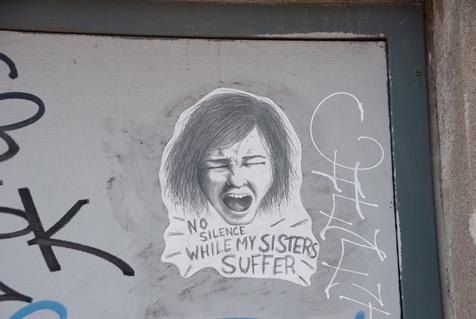
FIGURE
4.
No silence while my sisters suffer wheatpaste created by Red Bandit.
Credit: A. A. Rodrigues, 2015.
The visual and textual content of this street art disrupts the traditional narrative of the weak Indigenous woman who cannot change the circumstances of her life and needs others to take care of her (Harding, 2006; Jiwani, 2009). Instead, it showcases a young woman refusing to remain in the background as issues that involve her, and women such as herself, are ignored. The interview provided by the artist confirmed that not only is it a reminder of the tragedy of missing and murdered Indigenous women and girls in Canada, but it is also a demonstration of an empowered young Indigenous woman. Her words and art do not shirk from bringing attention to this issue even though it can be difficult to do that in a media cycle that is controlled by the dominant Western culture. By putting forth a different representation of an empowered Indigenous woman through her street art, the artist was successful in taking control away from the traditional media and their typical narratives of the weak Indigenous woman.
CONCLUSION
Street art, such as the works described in this article, provides a vital and much-needed counternarrative to the misrepresentations of Indigenous women and girls found in Canadian media. Various studies from the past 15 years have demonstrated that media tropes of female indigeneity are not historical records but rather contemporary racist and sexist narratives that are still very actively used in Canadian mass media (Elliot, 2016; McDiarmid, 2019; Palmater, 2016; Tucker, 2016). These pieces are also making visible what is invisible in much of Canadian society. Research shows that Indigenous women and girls are many times forgotten in mainstream media, where negative representations abound and positive portrayals are rare. Public street art, such as the four pieces analyzed in this article, brings to life the lived experiences of Indigenous women and girls while bringing to the forefront information on Indigenous cultural practices. In addition, these public pieces have the potential to educate by being a stimulus for conversations on the specific effects that settler colonization has had, and continues to have, on Indigenous women and girls in Canada.
As mainstream mass media in Canada continues to misrepresent or ignore the lived experiences of Indigenous women and girls, changing these narratives through other mediums, such as social media, can change the dominant discourse (Moeke-Pickering et al., 2018). This becomes of increased significance when looking at research that indicates how harmful representations may contribute to the ongoing violence Indigenous women and girls experience in Canada (Jiwani & Young, 2006; Palmater, 2016). Street art is currently an unconventional medium when compared to traditional methods of broadcasting information. These pieces are important to consider, as they are resisting the negative, misrepresented, and missing stories on Indigenous women and girls in Canadian mass media through the act of taking up space and encouraging conversations that might not happen otherwise.
Notes
The Indian Act does not include the Métis or the Inuit (Joseph, 2018).
The man charged with Tina Fontaine’s murder, Raymond Joseph Cormier, was found not guilty. Currently, her murder remains unsolved.
These descriptions included written notes from analyzing the work on the street, analyzing the image I took of the street art, reading about the artists behind each of the pieces, the artists’ comments on their work (when available), and media coverage from news outlets on the pieces and/or artists (when available).
The murals created as part of the Womxn Paint 2019 event were demolished in spring 2021 due to a transit project (Aguilar, 2021).
References
Aguilar, B. (2021, March 15). Stretch of murals in north Etobicoke to be demolished as part of Finch West LRT construction. CTV News. https://toronto.ctvnews.ca/stretch-of-murals-in-north-etobicoke-to-be-demolished-as-part-of-finch-west-lrt-construction-1.5347288
Anderson, K. (2009). Leading by action: Female chiefs and the political landscape. In G. G. Valaskakis, M. D. Stout, & E. Guimond (Eds.), Restoring the balance: First Nations women, community, and culture (pp. 99–123). University of Manitoba Press.
Anderson, K. (2016). A recognition of being: Reconstructing Native womanhood (2nd ed.). Women’s Press.
Bédard, R. E. M. (2019). Holding and carrying our babies: A gift-giving practice in Anishinaabeg mothering cultural traditions. Canadian Woman Studies, 34(1–2), 67–77. https://cws.journals.yorku.ca/index.php/cws/article/view/37799
Bogerts, L. (2017). Mind the trap: Street art, visual literacy, and visual resistance. Street Art & Urban Creativity, 3(2), 6–10. https://doi.org/10.25765/sauc.v3i2.76
Boscaino, M. (2021). Developing a qualitative approach to the study of the street art world. Street Art & Urban Creativity, 7(2), 8–25. https://doi.org/10.25765/sauc.v7i2.473
Brant, J. (2014). From historical memories to contemporary visions: Honouring Indigenous maternal histories. Journal of the Motherhood Initiative, 5(1), 35–52.
Dentith, A. M., O’Malley, M. P., & Brady, J. F. (2014). Public pedagogy as a historically feminist project. In J. Burdick, J. A. Sandlin, & M. P. O'Malley (Eds.), Problematizing public pedagogy (pp. 26–39). Routledge.
Elliot, C. (2016). You will be punished: Media depictions of missing and murdered Indigenous women (Publication No. 1863) [Master’s thesis, Wilfrid Laurier University]. Scholars Commons @ Laurier. https://scholars.wlu.ca/etd/1863
Galloway, G. (2012, December 26). As protests swell, Attawaspiskat chief stands firm on hunger strike. The Globe and Mail. https://www.theglobeandmail.com/news/national/as-protests-swell-attawapiskat-chief-stands-firm-on-hunger-strike/article6734968/
Ghani, B. (2021). Culture and conflict: Kabuli art as public pedagogy. Journal of Curriculum and Pedagogy, 18(3), 273–294. https://doi.org/10.1080/15505170.2020.1832002
Green, R. (1975). The Pocahontas perplex: The image of Indian women in American culture. The Massachusetts Review, 16(4), 698–714. https://www.jstor.org/stable/25088595
Gunther, A. (2022). Murals & mother nature: Urban environmental art in Lisbon reveals great concern and appreciation for the environment. Independent Study Project Collection, Article 3443. https://digitalcollections.sit.edu/isp_collection/3443
Harding, R. (2006). Historical representations of Aboriginal People in the Canadian news media. Discourse & Society, 17(2), 205–235. https://doi.org/10.1177/0957926506058059
Holmes, A. (2014). Street art as public pedagogy & community literacy: What walls can teach us. Ubiquity: The Journal of Literature, Literacy, and the Arts, 1(1), 34–48. https://ed-ubiquity.gsu.edu/wordpress/holmes-1-1/
Iddings, A. C. D., McCafferty, S. G., & da Silva, M. L. T. (2011). Conscientização through graffiti literacies in the streets of a São Paulo neighborhood: An ecosocial semiotic perspective. Reading Research Quarterly, 46(1), 5–21. https://doi.org/10.1598/RRQ.46.1.1
Jiwani, Y. (2009). Symbolic and discursive violence in media representations of Aboriginal missing and murdered women In D. Weir & M. Guggisberg (Eds.), Understanding violence: Contexts and portrayals (pp. 63–74). Inter-Disciplinary Press.
Jiwani, Y., & Young, M. L. (2006). Missing and murdered women: Reproducing marginality in news discourse. Canadian Journal of Communication, 31(4), 895–918. https://doi.org/10.22230/cjc.2006v31n4a1825
Joseph, B. (2018). 21 things you may not know about the Indian Act: Helping Canadians make reconciliation with Indigenous Peoples a reality. Indigenous Relations Press.
Journalists for Human Rights. (2020, December 14). MMIWG and the media: Getting it right [Video]. YouTube. https://youtu.be/CfROvGT4UYU
Konnikova, M. (2014, December 17). How headlines change the way we think. The New Yorker. https://www.newyorker.com/science/maria-konnikova/headlines-change-way-think
Longstaffe, M. (2017). Indigenous women as newspaper representations: Violence and action in 1960s Vancouver. The Canadian Historical Review, 98(2), 230–260. https://muse.jhu.edu/article/660138
McDiarmid, J. (2019). Highway of tears: A true story of racism, indifference and the pursuit of justice for missing and murdered Indigenous women and girls. Atria Books.
Moeke-Pickering, T., Cote-Meek, S., & Pegoraro, A. (2018). Understanding the ways missing and murdered Indigenous women are framed and handled by social media users. Media International Australia, 169(1), 54–64. https://doi.org/10.1177/1329878X1880373
Monkman, L. (2016, March 26). Behind First Nations headdresses: What you should know. CBC.ca. https://www.cbc.ca/news/indigenous/behind-first-nations-headdresses-1.3506224
Nahwegahbow, A. K. (2017). From great-grandmothers to great-granddaughters: “Moving life” in baby carriers and birchbark baskets. RACAR : Revue d'art canadienne / Canadian Art Review, 42(2), 100–107. https://www.erudit.org/en/journals/racar/2017-v42-n2-racar03379/1042949ar/
National Inquiry into Missing and Murdered Indigenous Women and Girls. (2019a). Reclaiming power and place: The final report of the National Inquiry Into Missing and Murdered Indigenous Women and Girls (Vol. 1a). https://www.mmiwg-ffada.ca/wp-content/uploads/2019/06/Final_Report_Vol_1a-1.pdf
National Inquiry into Missing and Murdered Indigenous Women and Girls. (2019b). Reclaiming power and place: The final report of the National Inquiry Into Missing and Murdered Indigenous Women and Girls (Vol. 1b). https://www.mmiwg-ffada.ca/wp-content/uploads/2019/06/Final_Report_Vol_1b.pdf
Paling, E. (2018, January 31). Assembly of Manitoba Chiefs calls out Globe and Mail for ‘victim blaming headline.’ The Huffington Post. https://www.huffpost.com/archive/ca/entry/assembly-of-manitoba-chiefs-calls-out-globe-and-mail-for-victim-blaming-headline_a_23349587
Palmater, P. (2016). Shining light on the dark places: Addressing police racism and sexualized violence against Indigenous women and girls in the national inquiry. Canadian Journal of Women and the Law, 28(2), 253–284. https://doi.org/10.3138/cjwl.28.2.253
Pfliger, A. (2020). The framing of Indigenous Canadian families: A historical discourse analysis. Canadian Journal of Family and Youth, 12(2), 69–83. https://doi.org/10.29173/cjfy29514
Razack, S. H. (2002). Gendered racial violence and spatialized justice: The murder of Pamela George). In S. H. Razack (Ed.), Race, space, and the law: Unmapping a White settler society (pp. 121–156). Between the Lines.
Rodrigues, A. A. (2018). Pop-up pedagogy: Exploring connections between street art, feminist literacy practices and communities [Doctoral dissertation, York University]. YorkSpace. http://hdl.handle.net/10315/34971
Rose, G. (2016). Visual methodologies: An introduction to researching with visual materials (4th ed.). Sage.
Stillman, S. (2007). ‘The missing White girl syndrome’: Disappeared women and media activism. Gender and Development, 15(3), 491–502. https://www.jstor.org/stable/20461232
Sunseri, L. (2008). Sky woman lives on: Contemporary examples of mothering the nation. Canadian Woman Studies, 26(3–4) 21–25. https://cws.journals.yorku.ca/index.php/cws/article/view/22108
Tam, B. Y., Findlay, L. C., & Kohen, D. E. (2017). Indigenous families: Who do you call family? Journal of Family Studies, 23(3), 243–259. https://doi.org/10.1080/13229400.2015.1093536
Tucker, A. (2016). Media and the perpetuation of Western bias: Deviations of ideality. Mount Royal University Institute for Community Prosperity. https://www.mtroyal.ca/nonprofit/InstituteforCommunityProsperity/_pdfs/icp_angie_studentreport.pdf
Unceded Voices. (2014, August 31). ITW #4 — Red bandit [Video]. YouTube. https://youtu.be/TPZwOVQK6nY
Viswanath, K., Ramanadhan, S., & Kontos, E. Z. (2007). Mass media. In S. Galea (Ed.), Macrosocial determinants of population health (pp. 275–294). Springer.
Wabie, J.-L. (2019). Kijiikwewin aji: Sweetgrass stories with traditional Indigenous women in Northern Ontario. International Journal of Indigenous Health, 14(2), 54–73. https://doi.org/10.32799/ijih.v14i2.31677
Wall of Femmes. (2010, November 10). Who what why. https://web.archive.org/web/20151013022246/http://www.walloffemmes.org/2010/11/who-what-why.html
Women Paint [@women_paint]. (2020, May 21). @natalielauraking is naturally resilient [Photograph]. Instagram. https://www.instagram.com/p/CAdC7JmAxBj/